
What Is Hidden Inside the Large White Domes Near Airports?
The large white spheres seen near some airports are not radars themselves. They are radomes: structures designed to protect antennas without preventing their signals from passing through.
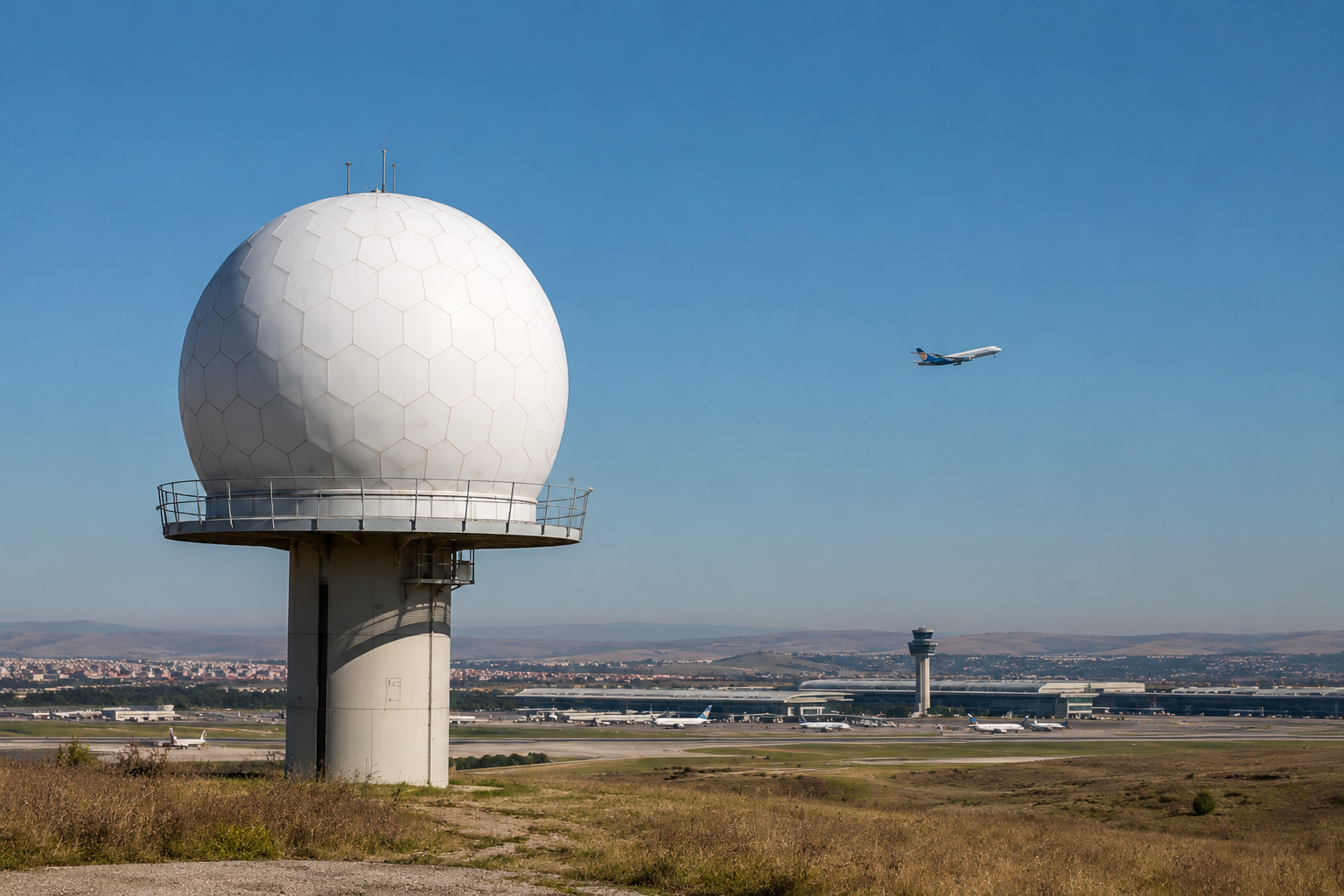
Anyone who regularly visits the area around an airport has probably noticed a large white sphere standing on top of a tower or a nearby hill.
Its shape may resemble a giant golf ball. From a distance, it could also be mistaken for a storage tank, a weather facility or some unusual type of antenna.
The structure is actually called a radome.
The radome is not the radar itself. It is the enclosure that protects the antenna and equipment installed inside, while allowing electromagnetic signals to pass through with as little interference as possible.
These structures are part of the landscape around many airports and air surveillance facilities. Radomes are also used at weather stations, military bases, on ships, at satellite communication sites and on the nose of many aircraft.
Where the word radome comes from
The word combines the English terms radar and dome.
Its main purpose is relatively straightforward: to provide a weather-resistant enclosure around an antenna without blocking the signals that the antenna needs to transmit and receive.
An antenna may be rotating continuously inside the sphere, even though no movement can be seen from outside.
ENAIRE explains that a radome protects the antenna against conditions such as rain, snow, hail and wind. It also creates a safer environment for technicians carrying out maintenance work at elevated sites.
Why a radar antenna needs protection
Some surveillance radar antennas are very large. They must rotate at a stable speed and maintain a precise orientation over long periods of operation.
Without a radome, the antenna could be directly exposed to:
Wind.
Rain and hail.
Snow and ice.
Dust and dirt.
Temperature changes.
Solar radiation.
Corrosion and moisture.
Strong wind can place considerable force on a large antenna. In addition to stressing the supporting structure and rotation mechanism, it may affect the stability of its movement.
Ice, water or accumulated dirt can also affect performance and increase maintenance requirements.
Inside the radome, the antenna operates in a much more protected and controlled environment. This makes it easier for the system to remain operational when conditions outside are less favourable.
How can a radar signal pass through a closed structure?
Radar works by transmitting and receiving electromagnetic energy. An antenna could not simply be enclosed inside an ordinary building made of metal, concrete or conventional glass.
A radome must be strong enough to withstand the weather while remaining almost transparent to the radio frequencies used by the antenna.
This is achieved using composite materials and specially designed panels intended to minimise signal loss.
The thickness, shape and joints between the panels are not selected purely for structural or visual reasons. They also affect how radio waves travel through the enclosure.
A poorly designed or damaged radome could:
Weaken the signal.
Reflect energy back towards the antenna.
Distort the antenna beam.
Introduce small errors in the apparent direction of a target.
Reduce the overall performance of the radar.
For this reason, a radome is not simply an optional shelter built around an existing radar. It forms part of the technical system and must be designed to work with the antenna inside.
Why are most radomes spherical?
A rounded structure distributes wind loads more evenly.
Unlike a large flat wall, a sphere does not present the same broad surface directly against the wind and can deal with forces arriving from different directions.
The shape also provides enough internal space for a large antenna to rotate freely.
Many radomes are constructed from numerous geometric panels joined together. This creates a large but relatively lightweight enclosure without requiring it to be manufactured as a single piece.
The lines visible from outside are the joints between these individual panels.
What can be installed inside a radome?
The sphere alone does not reveal what type of equipment it contains.
A radome may protect:
A primary surveillance radar.
A secondary surveillance radar.
A combined primary and secondary radar installation.
A weather radar.
A communications antenna.
Other civilian or military sensors.
Around airports, primary and secondary surveillance systems are often installed together.
A primary radar transmits pulses and detects the small amount of energy reflected when those pulses strike an object. It can detect the physical presence of an aircraft without requiring the aircraft to transmit a reply.
A secondary radar sends interrogations to aircraft transponders. The aircraft replies actively with information such as its identification and altitude, depending on the mode and equipment available.
EUROCONTROL explains that modern air traffic control relies heavily on secondary surveillance and Mode S to obtain identification and additional flight data. Primary radar nevertheless remains valuable because it can detect targets that are not transmitting through a transponder.
The difference between these technologies will be explored in a later part of this series.
Does every radar have a radome?
No. Some large rotating antennas operate fully exposed to the weather.
Whether a radome is installed depends on factors such as:
The type and size of the antenna.
Local weather conditions.
Typical wind strength.
The frequencies used.
Maintenance requirements.
Installation cost.
The structural design of the radar.
Some antennas are specifically designed to withstand outdoor conditions. In other cases, the size of the required radome, its potential effects on the signal or its maintenance cost may make an enclosure unsuitable.
A radar without a white dome is therefore not necessarily less advanced or less accurate. It simply uses a different design and protection strategy.
Not every white dome serves the same purpose
From a distance, different radomes may look almost identical. The systems inside them can nevertheless perform completely different functions.
An air surveillance radar is intended primarily to detect and track aircraft.
A weather radar analyses echoes produced by rain, snow and hail to estimate the intensity and movement of precipitation.
Other radomes protect satellite communication antennas or military systems.
The external shape alone is not enough to identify the equipment inside. This requires information about the site, its published role and the organisation operating it.
The radomes near Madrid-Barajas
Several large white radomes can be seen around Madrid-Barajas Airport.
Some belong to surveillance systems serving the airport and the surrounding Madrid airspace. One is located inside the airport grounds, while other installations are positioned near Paracuellos de Jarama.
In March 2026, ENAIRE announced the replacement of the antenna, rotating pedestal and radome at one of the radar sites serving Madrid-Barajas. The installation is particularly important for monitoring the airport’s independent parallel approaches.
Madrid-Barajas does not, however, depend on a single dome or sensor.
In the next Hangar article, we will look at the main radars serving the airport, why they are located at different sites and how they complement one another to provide redundant surveillance.
A simple enclosure protecting a complex system
The radome may be the most visible part of a radar facility, but it reveals very little about the activity taking place inside.
Beneath the sphere, an antenna may be rotating continuously, transmitting signals, receiving echoes and supplying information to the systems used to manage air traffic.
Its role may appear secondary, but without a suitable enclosure, the antenna would be more exposed to weather, greater structural loads and more demanding maintenance conditions.
The next time we see one of these large white spheres near an airport, we will know that we are not looking at the radar itself.
We are looking at the structure that allows an extremely sensitive system to continue operating, rotation after rotation, while protected from the outside world.
Sources
About the author
WNGLTS is the channel’s editorial voice, where we share articles about aviation, plane spotting, Madrid-Barajas, and everything that happens around our live streams.
Comments
If you want, you can leave a comment below. We review every submission before it appears publicly.
Moderation is manual, so approved comments may take a little while to appear.
To reduce spam, repeated submissions, suspicious links or automated patterns may be filtered automatically.
First time here? After clicking send, check your inbox to confirm the comment.
Share this article
Pass it along on your usual channels or copy the direct link.
Enjoying WNGLTS?
Subscribe to the YouTube channel and hit the bell 🔔 so you never miss a live stream or a new video. It's free and helps us a lot.
Subscribe on YouTube