
Madrid-Barajas prepares for its next major transformation
Madrid-Barajas is approaching the capacity for which its current terminal system was designed. Its next expansion will transform T4 and T4S, modernise T1-T2-T3 and prepare the airport for further growth without adding another runway.
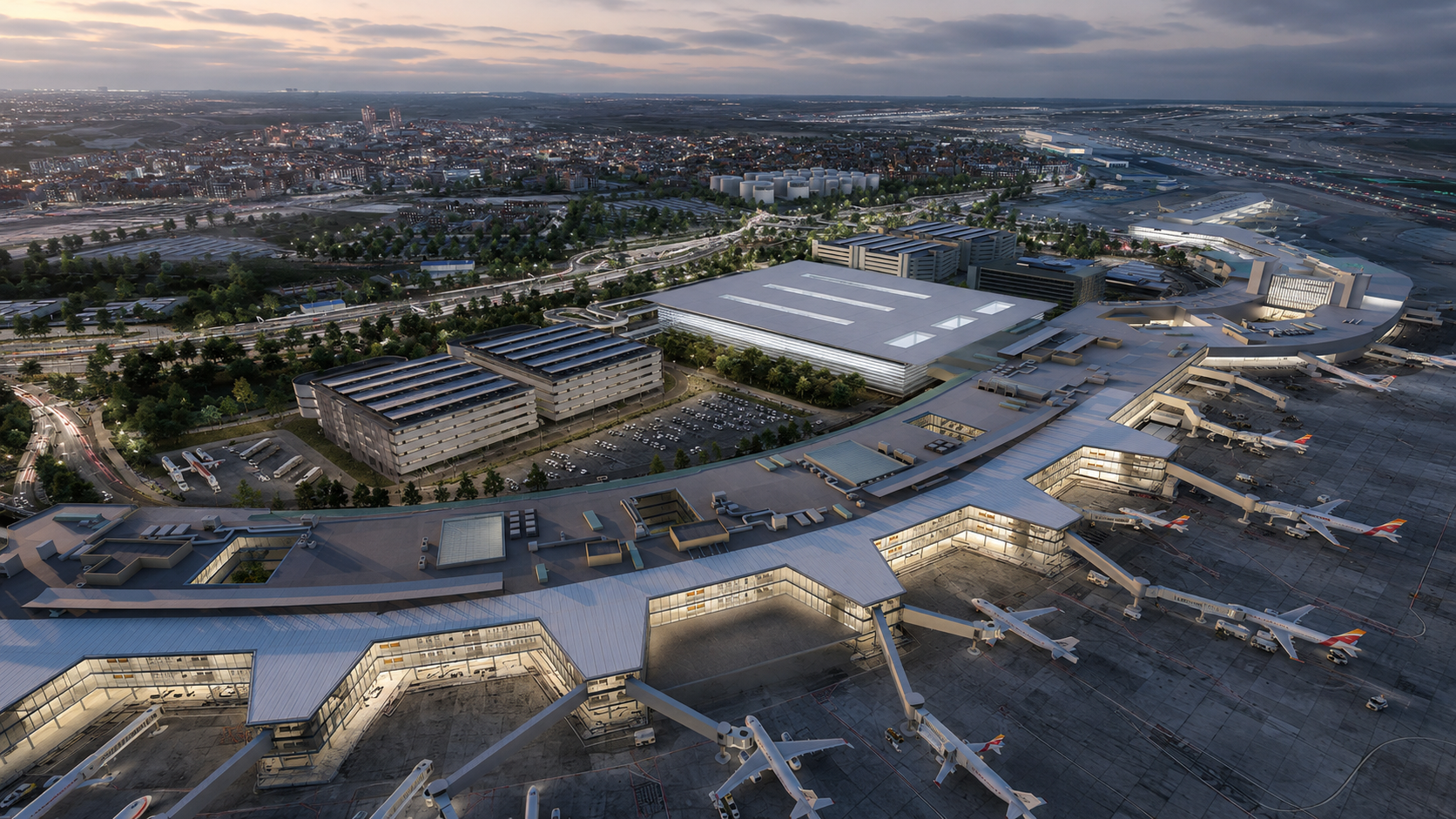
Two decades after Terminal 4 opened, Adolfo Suárez Madrid-Barajas Airport is preparing for another major transformation.
This will not be a repeat of the vast project completed in 2006, when Madrid gained the new T4 complex, a satellite terminal and two additional runways. The next expansion will focus on making better use of the airport’s four existing runways while enlarging its terminals and reorganising many of the areas used by passengers, baggage and aircraft.
The objective is easy to describe, even though delivering it will be extremely complex: Madrid-Barajas needs to keep growing without allowing its terminals, aircraft stands and access links to become permanent bottlenecks.
An airport approaching its current capacity
Madrid-Barajas handled a record 68,179,054 passengers in 2025. It also recorded 430,616 aircraft movements and more than 840,000 tonnes of cargo. Around 51.4 million passengers travelled on international services, underlining the airport’s position as Spain’s main international gateway and a major connecting hub between Europe and Latin America.
Those figures matter because the infrastructure opened in 2006 increased the airport’s estimated annual capacity from around 35 million to 70 million passengers. The four-runway layout also provided capacity for up to 120 aircraft movements per hour.
This does not mean the airport will suddenly stop working as soon as it passes 70 million passengers. Airport capacity is not a fixed counter. It depends on the distribution of flights throughout the day, aircraft size, connecting times, security controls, baggage systems and the availability of boarding gates.
However, recent traffic records show that parts of the airport are becoming increasingly busy. The expansion is intended to address that pressure before it begins to have a lasting effect on passenger comfort or operational reliability.
No fifth runway
One of the most important aspects of the project is what Madrid-Barajas will not receive.
The expansion does not include a fifth runway. Aena believes the airport’s four existing runways can provide sufficient capacity for the foreseeable future. The main constraints are now found around the terminals, aircraft parking areas and passenger-processing facilities.
This makes the current plan very different from the major expansion carried out at the beginning of the century. At that time, Madrid needed both more terminal space and considerably more runway capacity. The new project is primarily about using the existing airfield more effectively.
The aircraft operating areas will not remain unchanged. Aprons will be enlarged and reorganised, new parking positions will be created and service areas around the terminals will be adapted. The number of runways, however, will remain the same.
How T4 and the satellite terminal will change
The most visible part of the expansion will affect Terminal 4 and Terminal 4 Satellite, commonly known as T4S.
T4 is the main processing building, containing check-in facilities, security controls, baggage reclaim and some departure gates. T4S is located between the runways and connected to the main terminal by an underground automated train. It handles many international and long-haul flights.
The project submitted for public consultation in January 2026 is divided into eleven main sections. These include the expansion and remodelling of the central processing areas in T4 and T4S, extensions to their northern concourses, new aircraft aprons and an extension of the southern T4S concourse with three additional contact stands.
A contact stand allows an aircraft to park beside the terminal so passengers can board through a passenger boarding bridge. Providing more of these stands reduces the need to transport travellers by bus to aircraft parked in remote areas.
A new regional aviation area and a reconfiguration of the southern T4 apron are also planned. This should allow the airport to manage smaller regional aircraft more efficiently, as their operational requirements differ from those of large long-haul jets.
The programme also includes new heating, cooling and electrical plants. Passengers may never see these facilities, but they are essential. Larger terminals require more power, climate control, baggage capacity and safety systems.
In other words, T4 and T4S will not simply receive larger buildings. Many of their internal systems and processes will have to be redesigned to handle additional passengers and flights.
The transformation of T1, T2 and T3
The historic terminal complex will form the other major part of the programme.
Aena plans to construct a new processor building in front of T1-T2-T3. In airport terminology, a processor is the building where functions such as check-in, security, baggage handling, arrivals and passenger distribution are concentrated.
It will not necessarily operate as a separate terminal with a new identity. Its main purpose will be to modernise and centralise processes that are currently spread across buildings developed during different periods of the airport’s history.
The boarding areas of T1, T2 and T3 will also be renovated. The intention is to improve passenger routes, increase capacity and create a more consistent experience while keeping the terminals open for domestic, European and intercontinental services.
This part of the programme may appear less spectacular than an entirely new terminal, but it will be operationally important. Modernising T1-T2-T3 will allow traffic to be distributed more effectively between the airport’s two main terminal complexes rather than placing most future growth on T4.
Better rail and metro connections
The project extends beyond the airport buildings. A central objective is to make Madrid-Barajas a better-connected transport hub.
The new high-speed rail access from Chamartín will use part of the infrastructure currently used by commuter trains. Sections of this route were originally built with mixed-gauge track so that they could eventually accommodate both conventional and standard-gauge high-speed services. In May 2026, Adif announced that the civil engineering platform for the new high-speed access had been completed.
The airport expansion will prepare and reserve space for the integration of these rail services.
Madrid is also planning to extend Metro Line 5 to the T1-T2-T3 complex. Aena and the Community of Madrid signed an agreement in 2024 to coordinate the new metro infrastructure with the airport.
Together, these projects are intended to increase the proportion of passengers arriving by public transport and connect the airport not only with central Madrid, but also more directly with Spain’s national rail network.
How much will the expansion cost?
Figures published during the past few years can be confusing because they do not all cover the same projects.
In 2023, Aena estimated an investment of approximately €2.4 billion for the terminal expansion programme: around €1.7 billion for T4 and T4S and €700 million for T1-T2-T3.
In March 2026, Aena announced a proposed total investment of €4.488 billion in Madrid’s airports during the 2027-2031 period. This figure has a wider scope than the earlier terminal estimate and also includes work at Madrid-Cuatro Vientos Airport. It would therefore be inaccurate to state that the entire €4.488 billion will be spent exclusively on expanding Madrid-Barajas.
The final investment programme will depend on Spain’s Airport Regulation Document for 2027-2031, commonly known as DORA III. As of July 2026, the document is still going through the approval process. The Spanish Council of Ministers is expected to approve the final version no later than September 2026.
When will construction begin?
Some of the work has already started, although it is not yet visible to most passengers.
Functional studies, engineering designs and administrative procedures have been under way for several years. In January 2026, the planned work on T4, T4S and their associated aircraft aprons entered public consultation as part of the environmental impact assessment process.
The most significant construction work is expected during the 2027-2031 investment period. A programme of this size will not be delivered as a single construction project. It will be divided into different contracts and phases according to traffic growth, operational requirements and available investment.
Madrid-Barajas will also have to remain open throughout the transformation. Work areas will need to be introduced gradually, services will have to be relocated and temporary passenger routes may be required, all while hundreds of flights continue to operate every day.
Some parts of the programme may therefore extend beyond 2031. DORA defines the main investment period, but it does not necessarily mean that every element of the expansion will be complete by the final day of that year.
Expanding an airport that cannot stop
Expanding an active airport is more like rebuilding part of a city than constructing a single building.
The works will have to coexist with passengers, aircraft, baggage, employees, roads, trains and safety systems that cannot simply be switched off. Aena has acknowledged that airports affected by this investment cycle must remain operational while they are being modernised, making service quality one of the main challenges of the programme.
The expansion must also complete the relevant environmental procedures. Madrid-Barajas lies close to protected areas associated with the Jarama and Henares river basins, and the effects of construction and future activity on noise, air quality, water, wildlife and nearby communities must be assessed.
Keeping the proposed work within the airport’s existing service area reduces the need for new land, but it does not remove the obligation to identify and mitigate potential environmental effects.
Madrid-Barajas for the coming decades
The next expansion of Madrid-Barajas will be less dramatic from the air than the project completed in 2006. There will be no two new runways and no completely separate terminal complex.
Its importance will be found elsewhere: more boarding gates, better-organised aircraft stands, higher-capacity terminals, renewed technical systems and stronger rail connections.
For passengers, a successful expansion should mean simpler journeys through the airport, less congestion and more ways to reach the terminals. For airlines, it should provide more room to operate and connect flights. For Madrid, it will help strengthen Barajas as one of the world’s main meeting points between Europe, Latin America and other global regions.
Important decisions, administrative procedures and several years of construction still lie ahead. Nevertheless, the transformation has already begun on paper. Twenty years after its previous major expansion opened, Madrid-Barajas is preparing for its next chapter.
About the author
WNGLTS is the channel’s editorial voice, where we share articles about aviation, plane spotting, Madrid-Barajas, and everything that happens around our live streams.
Comments
If you want, you can leave a comment below. We review every submission before it appears publicly.
Moderation is manual, so approved comments may take a little while to appear.
To reduce spam, repeated submissions, suspicious links or automated patterns may be filtered automatically.
First time here? After clicking send, check your inbox to confirm the comment.
Share this article
Pass it along on your usual channels or copy the direct link.
Enjoying WNGLTS?
Subscribe to the YouTube channel and hit the bell 🔔 so you never miss a live stream or a new video. It's free and helps us a lot.
Subscribe on YouTube