
Inside the Rolls-Royce Centre That Listens to Aircraft Engines Around the World
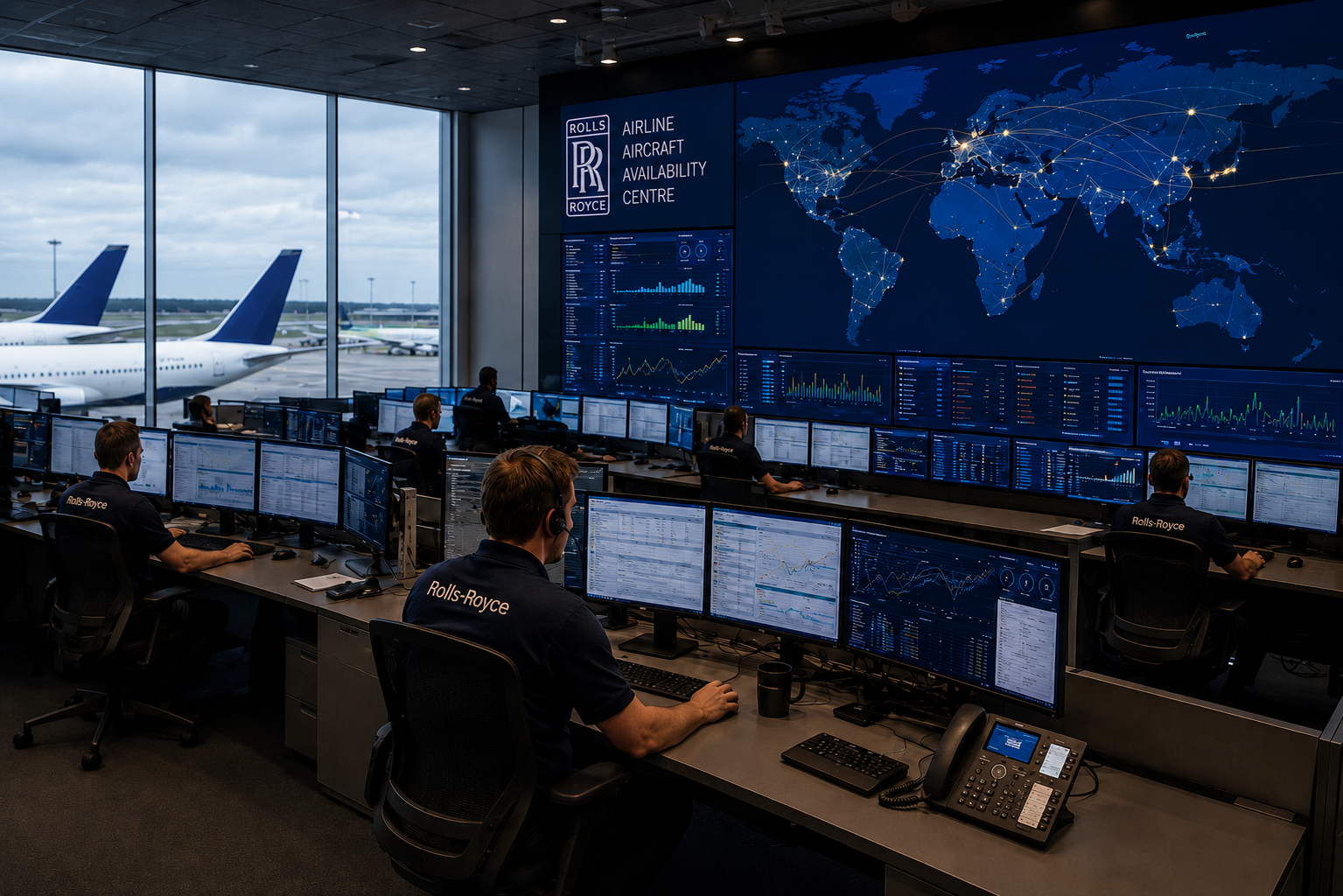
Every flight generates valuable data about the health of its engines. At its Airline Aircraft Availability Centre in Derby, Rolls-Royce analyses that information to detect anomalies, plan maintenance and help airlines maximise fleet availability.
When watching an Airbus A350, a Boeing 787 or an Airbus A330neo take off, most of us naturally focus on the airline, the livery, the distinctive sound or the aircraft itself. Yet beneath the wings, something equally fascinating is happening—something passengers never see.
Modern aircraft engines generate an enormous amount of data. Temperatures, pressures, rotational speeds, vibration levels, fuel flow, component behaviour, environmental conditions and countless operating parameters are continuously monitored throughout every flight. Much of this information can later be transmitted to ground-based systems for detailed analysis.
For Rolls-Royce, one of the world’s leading aircraft engine manufacturers, this process is centred around the Airline Aircraft Availability Centre (AAAC) in Derby, United Kingdom. Despite its impressive name, it is not a control tower, nor is it a facility where engineers remotely control aircraft engines. Instead, it is a 24/7 operational support centre dedicated to helping airlines maximise aircraft availability by analysing engine data, coordinating maintenance activities and providing technical support whenever required. Rolls-Royce describes the facility as a single point of operational support for long-haul customers, combining engineering expertise, engine operations planning and advanced data analytics to keep fleets flying.
It Doesn’t Control Engines — It Monitors Their Health
The phrase engine control centre sounds dramatic, but it can also be misleading.
Nobody in Derby is adjusting engine thrust, changing power settings or remotely flying an aircraft. The engines remain entirely under the control of the aircraft’s onboard systems, the Full Authority Digital Engine Control (FADEC), and ultimately the flight crew.
What Rolls-Royce actually does is far more subtle—and arguably even more impressive. Its engineers continuously monitor engine health, analyse operational data, identify unusual behaviour and recommend maintenance actions before small issues become operational problems.
The company refers to this service as Engine Health Monitoring (EHM). According to Rolls-Royce, its EHM systems analyse data collected from every engine and every flight to optimise maintenance schedules while maximising engine availability.
This distinction is important.
The centre is not “driving” the engines from the ground. It is listening to what every engine is saying through the thousands of data points it produces during each flight.
What Kind of Information Can an Aircraft Engine Send?
A modern commercial jet engine is one of the most sophisticated machines ever built. Knowing whether it is running—or even how much thrust it is producing—is only a tiny part of the picture.
To understand an engine’s overall condition, engineers analyse a wide range of parameters. Some describe its normal operation:
Compressor and turbine rotational speeds
Temperatures throughout the engine
Pressures at different stages
Fuel flow
Response to power changes
Others are used to detect long-term trends:
Vibration signatures
Exhaust gas temperature margins
Component efficiency
Progressive performance degradation
Behaviour compared with historical data
Rolls-Royce explains that its Engine Health Management system transfers engine data from aircraft to operational centres on the ground, where specialists monitor and analyse the information to help ensure continued engine availability.
The company also notes that its latest systems are capable of collecting thousands more parameters than previous generations, providing visibility into engine areas that were previously impossible to monitor in such detail.
However, individual data points are rarely the most valuable part. What truly matters is the trend.
A parameter may still be operating well within acceptable limits while gradually evolving in an unexpected direction. Detecting that subtle change early allows maintenance teams to plan inspections, prepare replacement parts, schedule workshop capacity or align maintenance with already planned aircraft downtime.
From the Engine to the Operations Centre
The overall process is surprisingly straightforward:
During the flight, the engine continuously records operational information.
Depending on the aircraft, communications systems and the type of data involved, some information can be transmitted during flight, while larger datasets are downloaded after landing.
Once received on the ground, the information is integrated into advanced analytical platforms. There, it is compared against:
Historical data from the same engine
Fleet-wide performance trends
Engineering models
Operational limits
Data from similar engines operating worldwide
The objective is not simply to decide whether an engine is “good” or “bad.” Instead, engineers ask operational questions such as:
Can this engine continue flying safely?
Should it be inspected at the next maintenance opportunity?
Can the inspection wait until the next scheduled check?
Should technical teams be deployed?
Does a replacement engine need to be prepared?
Would replacing the engine now prevent future flight disruptions?
Back in 2019, Rolls-Royce explained that its Airline Aircraft Availability Centre had already spent fifteen years supporting widebody operators around the globe. During that period, the scale of available data had grown dramatically—from kilobytes collected per flight to terabytes—allowing engineers to make faster and more informed operational decisions.
Why This Matters to Airlines
For an airline, an aircraft engine is far more than an engineering component. It is one of the most critical assets in the entire operation.
An unexpected inspection can ground an aircraft. A missing spare engine can lead to cancellations. A technical issue occurring far from a maintenance base may require complex logistical solutions involving engineers, replacement parts and recovery planning.
Every delay affects passengers, crews, connecting flights, airport slots, airline reputation and operating costs. This is why Rolls-Royce’s objective is not simply to repair engines. Its goal is to keep them flying for as long as possible.
The company’s TotalCare philosophy reflects exactly this approach. Rather than focusing solely on maintenance events, Rolls-Royce manages the engine throughout its operational life, aligning its own success with that of the airline.
Simply put:
If the aircraft keeps flying, everybody wins.
If it remains on the ground, the consequences are not only technical—they are also operational and financial.
TotalCare: When the Manufacturer Also Manages the Risk
For decades, aircraft engine manufacturers have earned far more than simply selling new engines. A significant part of their business revolves around long-term maintenance, overhaul programmes, spare parts, engineering support and ensuring that engines remain available throughout their operational life.
Rolls-Royce was one of the pioneers of a concept that has since become well known across the aviation industry: Power by the Hour. Instead of purchasing maintenance as individual events, airlines pay according to the hours the engine spends in operation.
In return, Rolls-Royce assumes much of the responsibility for keeping the engine available, planning maintenance activities and managing technical support.
This philosophy eventually evolved into TotalCare, one of the company’s flagship service programmes. Rather than simply repairing engines when something goes wrong, TotalCare aims to manage the engine throughout its entire lifecycle.
According to Rolls-Royce, the programme includes predictive maintenance planning, work scope management, on-wing support, shop visits, overhauls and engineering services, while transferring much of the operational risk from the airline to the manufacturer. This fundamentally changes the relationship between both parties.
Airlines are no longer simply buying an engine.
In many cases, they are purchasing availability. Behind every engine there is an ecosystem of engineers, logistics specialists, maintenance planners, spare parts, digital services and operational support working together to maximise the time that aircraft spend flying rather than sitting in a hangar.
The Airline Aircraft Availability Centre in Derby is one of the central pieces of that ecosystem.
The Engines Behind the Data
Rolls-Royce has long specialised in engines for widebody aircraft and business aviation.
Among its best-known commercial products are:
Trent XWB, powering the Airbus A350.
Trent 1000, developed for the Boeing 787 Dreamliner.
Trent 7000, designed specifically for the Airbus A330neo.
These engines operate some of the world’s longest and most demanding routes. An Airbus A350 may spend more than fifteen hours crossing continents. A Boeing 787 can fly between airports with completely different climates, altitudes and operational profiles. An A330neo may alternate between medium-haul services one day and intercontinental flights the next.
Every one of those missions leaves its own fingerprint on the engine. Operating in hot desert environments is not the same as flying through cold northern climates. Frequent departures from high-altitude airports affect the engine differently than operations at sea level. Exposure to dust, humidity, volcanic ash or salt-laden air can also influence long-term performance.
By continuously monitoring engine data, Rolls-Royce can understand how each individual engine ages under its own unique operating conditions rather than relying solely on theoretical maintenance intervals.
From Scheduled Maintenance to Predictive Maintenance
Traditional aircraft maintenance has always followed carefully regulated schedules. After a specific number of flight hours, flight cycles or calendar months, inspections and maintenance tasks are performed regardless of the engine’s apparent condition.
Those programmes remain essential. Commercial aviation is built upon highly regulated maintenance procedures approved by aviation authorities around the world.
However, modern data analysis adds another dimension.
Instead of relying exclusively on fixed maintenance intervals, operators can increasingly consider condition-based maintenance. If engine data shows stable behaviour over time, maintenance can often be aligned with planned operational stops. If subtle anomalies begin to appear, engineers may recommend an earlier inspection before the issue develops into a more significant operational event.
According to Rolls-Royce, Engine Health Monitoring continuously analyses operational data, detects abnormal behaviour, identifies possible causes and provides maintenance recommendations tailored to each operator. Those recommendations may range from specific maintenance manual tasks to customised engineering advice delivered directly to airline technical teams.
The real challenge is not collecting data. It is transforming millions of technical measurements into practical operational decisions.
A temperature reading alone tells very little. Engineers must determine whether the variation is meaningful, whether it fits an expected trend, how likely it is to develop further and what action—if any—should be taken.
The Power of Looking at Thousands of Engines
An airline only sees its own fleet. Rolls-Royce, however, can observe patterns across thousands of engines operating for hundreds of customers around the world.
That scale provides an enormous advantage.
If several engines begin showing the same subtle behaviour, engineers may identify an emerging technical trend long before it becomes a widespread operational issue. If unusual data appears only in a specific geographic region, environmental conditions may be the cause. If similar behaviour occurs after particular maintenance activities, engineers can investigate whether there is a common underlying factor.
According to Rolls-Royce, its Engine Health Monitoring service currently supports more than 8,000 civil and business aircraft, combining engineering knowledge gathered across customers, regions, operational profiles and engine families. This global perspective allows the manufacturer to recognise patterns that would be almost impossible for an individual airline to detect on its own.
It is one of the greatest advantages of having the engine manufacturer involved in long-term fleet support. Rolls-Royce not only designed the engine. It also sees how that engine behaves throughout its operational life in virtually every environment around the world.
When the Engine “Talks” to the Ground
For several years Rolls-Royce has promoted a broader vision known as IntelligentEngine. The concept goes beyond simply building efficient engines. It imagines engines as connected, data-driven systems capable of continuously sharing information throughout their operational life.
Earlier generations of monitoring systems typically collected a relatively limited set of parameters after each flight. Modern systems are far more capable. If engineers need to investigate a specific event, today’s engines can provide far more detailed information focused on the exact area of interest.
Rolls-Royce explains that its latest Engine Health Monitoring technologies allow specialists to request additional information from particular engine sections, receiving hundreds of hours of operational data relevant to a specific investigation.
This represents an important shift. Monitoring is no longer entirely passive.
When engineers detect something unusual, they can request deeper insight, analyse additional parameters and refine their diagnosis without immediately removing the engine from service. In many ways, the engine becomes an active participant in its own maintenance process. Rather than simply reporting faults, it helps engineers understand what is happening inside long before anyone opens the engine.
Humans, Data and Artificial Intelligence
When people imagine facilities like the Airline Aircraft Availability Centre, they often picture a room full of giant screens where artificial intelligence decides which engines should remain in service and which should be removed.
Reality is rather more balanced.
Artificial intelligence is becoming an increasingly valuable tool, but it is not replacing engineering judgement. Algorithms can analyse enormous volumes of information, identify unusual patterns and prioritise events that deserve attention. However, maintenance decisions in commercial aviation still rely on certified procedures, engineering expertise, regulatory requirements and human responsibility.
Rolls-Royce explains that combining advanced analytics, engineering knowledge and artificial intelligence enables faster and more accurate assessments of engine condition. Yet the final outcome remains the same: providing practical recommendations that airlines can use to maintain safe and reliable operations.
The real value of AI is not making decisions on its own. It is helping engineers make better decisions sooner.
A single data point may trigger an alert, but understanding its significance requires context. Engineers must consider the aircraft’s operational history, previous maintenance activities, environmental conditions, fleet-wide trends and the certified maintenance programme before deciding what action should be taken.
Artificial intelligence accelerates the analysis, engineering expertise provides the judgement.
Looking Inside an Engine Without Taking It Apart
One of the most interesting aspects of the Airline Aircraft Availability Centre is how it supports maintenance teams working anywhere in the world. Rolls-Royce has developed collaboration systems that allow engineers performing inspections at remote airports to share live images from inside an engine with specialists based in Derby. Instead of waiting for reports to be exchanged or flying experts across continents, technical teams can discuss findings in real time.
This significantly reduces decision-making time.
If an engineer identifies something unusual during a borescope inspection, specialists at the Operations Centre can immediately review the images, compare them with previous cases and recommend the most appropriate course of action. Sometimes the inspection confirms that the engine can safely continue operating. Sometimes a component should be replaced. Occasionally, a more extensive maintenance event becomes necessary. The important point is that those decisions can now be made far more quickly than in the past.
Rolls-Royce has also explored concepts such as remote maintenance support and digital twins as part of its long-term vision for future engine services, where physical inspections are increasingly complemented by digital analysis and collaborative engineering.
Why Data Cannot Prevent Every Technical Issue
Modern monitoring systems are incredibly powerful. However, they do not eliminate technical problems.
Aircraft engines remain among the most complex machines ever built. They operate under extreme temperatures, enormous mechanical loads, high rotational speeds and demanding environmental conditions for thousands of hours. Even with continuous monitoring, components eventually wear, maintenance remains essential and unexpected events can still occur.
The aviation industry has also faced significant challenges in recent years, including supply chain constraints, limited maintenance capacity and durability issues affecting several engine families across different manufacturers.
In this environment, data becomes even more valuable. It helps airlines decide:
Which engine requires attention first.
Which maintenance event can safely wait.
Where spare engines should be positioned.
How engineering resources should be allocated.
How to minimise operational disruption.
Monitoring does not remove complexity. It helps operators manage it more intelligently.
The Passenger Never Sees Any of This
For passengers, all of this work remains almost completely invisible.
Nobody chooses a flight because its engines are monitored through Engine Health Monitoring. Nobody boards an aircraft thinking about TotalCare contracts or predictive maintenance algorithms. And if everything works as intended, nobody notices anything unusual at all.
That is precisely the objective.
The ideal maintenance programme is the one passengers never realise exists. Its purpose is simple:
To ensure the aircraft departs on time.
To minimise unexpected technical interruptions.
To identify potential issues before they become operational problems.
On long-haul aircraft, where a single delay can affect multiple flights across several continents, maintaining engine availability is particularly important.
Passengers see a departure time. Airlines see an aircraft rotation. Rolls-Royce sees a continuous flow of operational data helping protect that entire operation.
A New Way of Thinking About Aircraft Engines
Not long ago, aircraft engines were viewed primarily as mechanical systems.
Today, they are also powerful sources of information.
Every flight generates new data. Every inspection contributes additional knowledge. Every maintenance event improves future analysis. Every engine operating around the world helps engineers better understand the entire fleet.
This is the philosophy behind Rolls-Royce’s vision of connected engines and digital services. Rather than treating engineering, maintenance and operational support as separate activities, they become parts of a single, continuously evolving system. The Airline Aircraft Availability Centre is one of the clearest examples of that transformation.
For aviation enthusiasts watching aircraft from the perimeter fence, the most exciting moment may still be the take-off: the sound, the acceleration, the rotation and the climb into the sky. Yet part of the future of aviation is happening far away from the runway.
It is happening inside operations centres where engineers analyse invisible streams of data, helping thousands of engines continue doing exactly what they were designed to do:
Fly safely. Fly efficiently. And keep flying.
Editorial note: This article is based on publicly available information published by Rolls-Royce regarding its Engine Health Monitoring, TotalCare and Airline Aircraft Availability Centre services. It does not include confidential operational procedures or restricted technical information.
About the author
WNGLTS is the channel’s editorial voice, where we share articles about aviation, plane spotting, Madrid-Barajas, and everything that happens around our live streams.
Comments
If you want, you can leave a comment below. We review every submission before it appears publicly.
Moderation is manual, so approved comments may take a little while to appear.
To reduce spam, repeated submissions, suspicious links or automated patterns may be filtered automatically.
First time here? After clicking send, check your inbox to confirm the comment.
Share this article
Pass it along on your usual channels or copy the direct link.
Enjoying WNGLTS?
Subscribe to the YouTube channel and hit the bell 🔔 so you never miss a live stream or a new video. It's free and helps us a lot.
Subscribe on YouTube