
The Aircraft That Fight Wildfires: Aviation’s Front Line Against Forest Fires
Discover how water bombers, helicopters and air tankers work together to fight wildfires and why aviation is essential in protecting forests and communities.
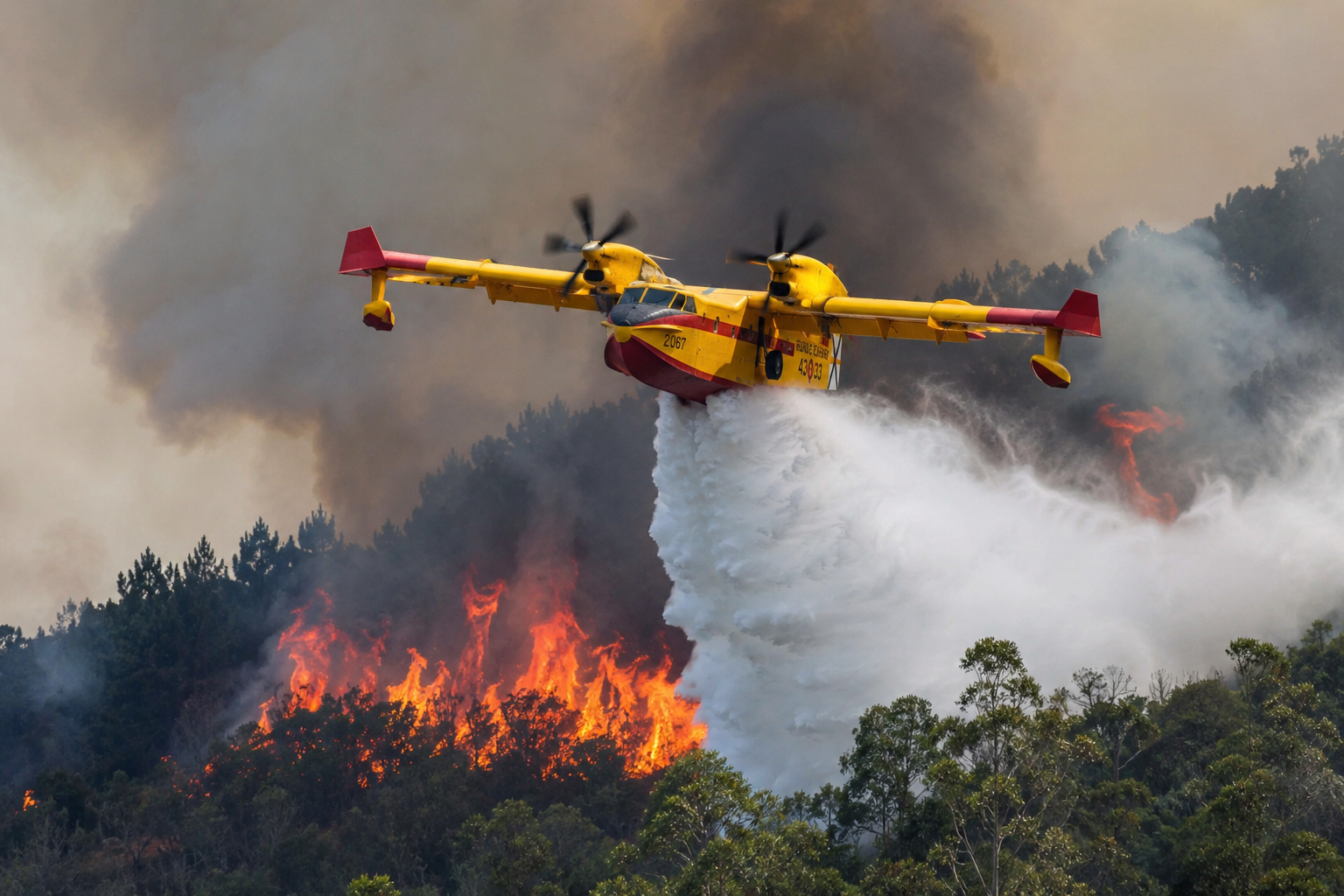
Every summer, the same dramatic images appear on television and social media: towering smoke columns rising above forests while bright yellow and red aircraft skim across lakes before disappearing into the smoke.
To most people, they are simply “Canadairs.”
In reality, these aircraft are part of one of the most demanding, coordinated and dangerous aviation operations anywhere in the world.
Aerial firefighting is far more than dropping water on flames. It requires exceptional flying skills, careful planning and seamless coordination between pilots, helicopters, ground crews and command centres. No aircraft extinguishes a wildfire alone, but every flight helps create the time and space needed for firefighters on the ground to bring the fire under control.
A Wildfire from the Cockpit
From the ground, a wildfire looks like an enormous wall of flames.
From the cockpit, it is a constantly changing environment.
Pilots must deal with strong winds, mountainous terrain, heavy smoke that can severely reduce visibility, intense turbulence created by the fire itself and several other aircraft operating at very low altitude.
Many missions are flown just a few dozen metres above the ground while carrying several tonnes of water or fire retardant.
These conditions make aerial firefighting one of the most challenging forms of professional flying.
The Famous Canadair Water Bombers
When people think about firefighting aircraft, the Canadair CL-215 and its successor, the CL-415, are usually the first aircraft that come to mind.
Their greatest advantage is that they do not always need to return to an airport to reload.
Instead, they can skim across a lake, reservoir or even the sea, collecting more than 6,000 litres of water in only a few seconds before climbing away and heading straight back to the fire.
This ability dramatically reduces turnaround times whenever a suitable body of water is available nearby.
In Spain, these aircraft are operated by the 43rd Group of the Spanish Air and Space Force, a specialised unit deployed throughout the country every wildfire season to support emergency services.
It Takes More Than Water Bombers
Although water bombers often receive most of the public attention, they are only one part of a much larger aerial operation.
Depending on the situation, firefighting efforts may also involve:
Air Tractor AT-802 aircraft capable of operating from short airstrips and delivering rapid initial attacks.
Large air tankers carrying fire retardant instead of water.
Helicopters equipped with external buckets or belly tanks.
Transport helicopters carrying specialist firefighting crews into difficult terrain.
Air attack and coordination aircraft responsible for managing the entire aerial operation.
Each aircraft has a different role, and together they operate as a single, highly coordinated team.
Water or Fire Retardant?
Not every aircraft drops water.
Water is especially effective during the early stages of a wildfire, helping to cool flames and reduce fire intensity.
As fires grow larger, however, many aircraft begin using fire retardant instead.
Unlike water, retardant is designed to slow combustion by coating vegetation, making it more difficult for flames to spread.
While water removes heat from the fire, retardant helps create defensive lines that support firefighters working on the ground.
A Perfectly Coordinated Air Operation
During a major wildfire, several helicopters, water bombers and air tankers may all be operating in the same airspace at the same time.
Every aircraft follows assigned routes, specific altitudes and carefully timed attack runs.
The objective is to maximise the number of effective drops while maintaining safe separation between aircraft.
In many ways, the level of coordination resembles that of a busy international airport—except everything is happening over rugged terrain, surrounded by smoke and an active wildfire.
Wind: The Invisible Enemy
Wind does much more than feed the flames.
It also determines how aircraft can safely operate.
Strong winds may push water away from its intended target, generate severe turbulence or force pilots to abort a drop at the very last moment.
This is why a release that appears inaccurate from the ground is often the result of a deliberate safety decision made by an experienced crew.
Safety always comes first.
The Future of Aerial Firefighting
As wildfires become more frequent and more intense across many parts of the world, governments and operators are investing in the next generation of firefighting aircraft.
One of the most anticipated additions is the De Havilland Canada DHC-515 Firefighter, the modern successor to the CL-415.
The new aircraft retains the proven amphibious concept while introducing updated avionics, improved maintenance efficiency and enhanced operational capabilities.
At the same time, drones, satellite imagery, artificial intelligence and predictive fire behaviour models are becoming increasingly important tools for planning aerial operations and deploying resources where they are needed most.
More Than Spectacular Flying
Watching a water bomber skim across a reservoir at high speed is undeniably impressive.
But behind every drop lies years of training, extensive planning and remarkable teamwork involving pilots, engineers, dispatchers, firefighters and emergency services.
The mission of these aircraft is not simply to extinguish fires.
Their mission is to buy time.
Time to protect forests.
Time to protect communities.
And, most importantly, time to save lives.
About the author
WNGLTS is the channel’s editorial voice, where we share articles about aviation, plane spotting, Madrid-Barajas, and everything that happens around our live streams.
Comments
If you want, you can leave a comment below. We review every submission before it appears publicly.
Moderation is manual, so approved comments may take a little while to appear.
To reduce spam, repeated submissions, suspicious links or automated patterns may be filtered automatically.
First time here? After clicking send, check your inbox to confirm the comment.
Share this article
Pass it along on your usual channels or copy the direct link.
Enjoying WNGLTS?
Subscribe to the YouTube channel and hit the bell 🔔 so you never miss a live stream or a new video. It's free and helps us a lot.
Subscribe on YouTube